

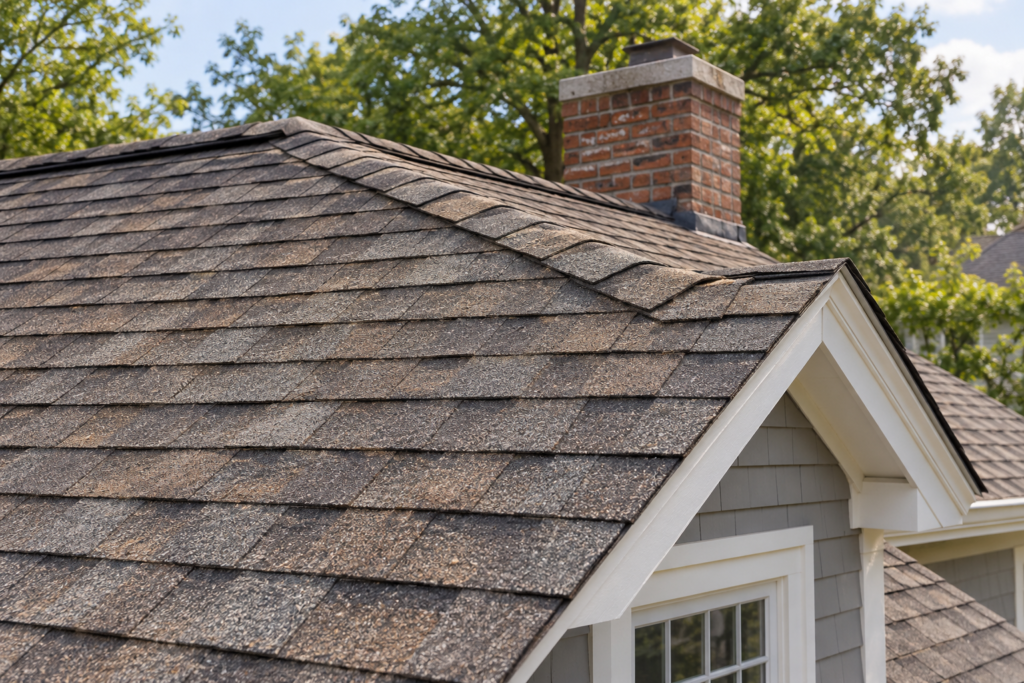
Cover image: AI-generated roofing illustration, not a photograph of a completed company project.
How long a roof lasts in New Jersey depends on the installed system, its original construction, exposure and current condition. Age helps organize replacement planning, but it cannot tell you whether a particular roof needs work today. Two roofs installed in the same year can reach very different conditions.
Use a lifespan estimate as a planning reference, then use condition evidence to decide what to do. A general range is neither a replacement deadline nor a promise of remaining service. The useful question is what the roof is doing now, which problems are developing and how much uncertainty remains.
What do general roof-life estimates mean?
GAF’s homeowner guidance uses roughly 20–25 years as a broad reference for many residential roofs, while explaining that material and condition influence replacement timing. That is general manufacturer guidance, not a study establishing an average for New Jersey homes.
Do not apply one range to asphalt shingles, metal, slate and low-slope membranes as if they were the same system. Even within one material family, product design, assembly and exposure vary. A responsible assessment identifies what is installed before discussing its likely stage of service.
Also separate an estimated total life from estimated remaining life. Knowing the installation date does not justify subtracting it from a generic number and treating the result as a reliable countdown.
Find out what roof you actually own
Look for installation invoices, product information, warranty documents and records of later repairs. Establish whether the last project removed the existing covering or installed another layer. Different roof sections may have different ages, especially where additions or localized replacements were completed.
If records are incomplete, tell the contractor what is known and what is uncertain. Avoid turning a previous owner’s estimate into an exact installation date. A planning file can clearly say “age unconfirmed” while still recording useful observations about current condition.
Document roof-mounted features and subsequent work as well. Changes around skylights, vents or other penetrations can matter when assessing a problem, even if the main covering is relatively recent.
What can change the roof’s useful life?
The complete assembly and installation
A roof is more than its exposed covering. The deck, underlayment, transitions and installation details all contribute to performance. A problem at one interface can require attention before the main field of roofing has broadly deteriorated.
That distinction matters financially. A localized defect does not automatically prove that the entire roof has reached the end of its life. Conversely, repeatedly treating one visible symptom may be insufficient when deterioration is widespread.
Exposure and weathering
Sunlight and weather affect roofing over time, but an owner cannot assign an exact number of years lost to UV exposure by looking at the roof. Evaluate the actual product and observed changes rather than buying an unsupported “UV protection” life-extension promise.
New Jersey is not one uniform exposure zone. Rutgers describes coastal and inland climate differences; a site’s surrounding trees, orientation and local conditions add further context. Those factors inform an assessment, but they do not produce a dependable statewide lifespan multiplier.
Moisture, drainage and previous problems
Recurring leakage deserves investigation regardless of the roof’s age. Keep dates, locations and photographs so the contractor can distinguish a repeated condition from a new one. For a roof with several sections, identify which area the history concerns.
Do not assume that a stain proves broad covering failure or that the absence of a visible stain proves everything is sound. Ask what observations support the conclusion and which areas were inaccessible.
Use condition to organize the next decision
| Current situation | Practical next step |
|---|---|
| Age is known, with no current concern | Keep records and follow appropriate care guidance; use age to plan future review. |
| Age is uncertain, with incomplete history | Establish the visible condition and document limitations before making a long-term budget assumption. |
| A localized symptom has appeared | Investigate its cause and repairability without assuming that age alone decides the scope. |
| Several areas show deterioration or recurring failures | Request an explanation of the overall condition and compare appropriate renewal options. |
This framework helps avoid two expensive mistakes: replacing a serviceable roof solely because it reached a birthday, or delaying necessary work because a generic chart suggests years should remain.
Why warranty duration is a different number
A warranty defines qualifying protection under written terms. It does not certify that every component will perform without maintenance for the full stated period. GAF’s residential warranty information, for example, distinguishes coverage types and eligibility conditions.
Keep the warranty in your project file, but do not use its headline term as the roof’s predicted replacement date. Ask separate questions about current condition, future planning and any protection that may apply to a documented problem.
Questions homeowners ask
Should I replace a roof before selling the house?
Base the decision on condition, the intended transaction and a realistic project scope. Do not assume replacement creates a particular resale return. A documented assessment can help clarify what work is actually justified.
Does a newer roof need attention?
It can. Installation details, later alterations or localized damage can create a problem before broad age-related deterioration. Investigate a new symptom rather than dismissing it because the roof is young.
Can a contractor tell me exactly how many years remain?
Ask for the basis and limitations of any estimate. A condition assessment can support planning, but an exact remaining-life guarantee should not be inferred from a visual visit.
Plan with evidence instead of a countdown
Use age to start the conversation and condition to shape the decision. A clear history, documented observations and an explanation of uncertainty provide a stronger basis for spending than a generic lifespan chart.
Contact American Siding & Construction about an aging roof. Share the known installation date and any recurring concerns to discuss appropriate roofing options. For the next decision, review the company’s repair-versus-replacement guide.