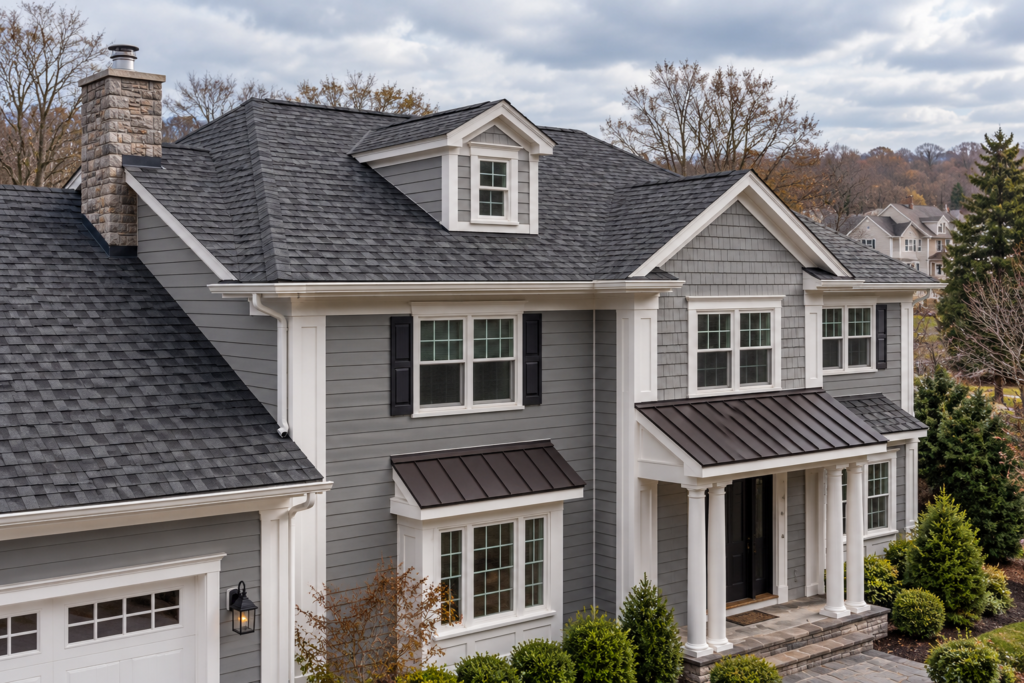


Cover image: AI-generated roofing illustration, not a photograph of a completed company project.
A leak can come from a limited defect in an otherwise serviceable roof. It can also be the visible sign of a wider problem. The decision between roof repair or replacement in New Jersey should begin with evidence about the cause, the surrounding materials and the feasibility of a durable repair.
Before agreeing to either scope, ask the contractor to explain what failed, how much of the roof is affected and what the proposed work will leave in place. Those answers are more useful than a roof-age cutoff or a rule based on a percentage of visible damage.
When does repair make sense?
A repair deserves consideration when the problem is localized, its cause can be addressed and the surrounding roof can support a sound connection. Replacement deserves closer evaluation when deterioration is widespread, multiple areas are failing or the proposed repair would depend on materials that are no longer serviceable.
GAF’s damage guidance distinguishes limited shingle damage from broader roof deterioration. That is a starting framework, not a diagnosis of a particular property. An old roof can have a repairable detail; a newer roof can have an installation problem requiring substantial corrective work.
Start with the cause, not the ceiling stain
Tell the contractor when water appears, which room is affected and whether the symptom follows rain, wind-driven rain or melting snow. Include earlier repairs and available photographs. A recurring stain after a repair should trigger a review of the original diagnosis rather than an automatic repeat of the same patch.
Ask what evidence connects the suspected roof defect to the indoor symptom. A useful explanation identifies the likely entry area, the materials involved and any uncertainty that remains. If the investigation suggests condensation, a wall detail or another building component, the work should address that source.
Do not climb onto the roof or remove shingles to prepare for the visit. Ground-level observations and existing project records are enough to begin. Keep away from a sagging ceiling or other visibly unstable area and obtain appropriate assistance.
Four questions that determine the right scope
1. Is the problem isolated or distributed?
A single damaged penetration detail is different from several unrelated failures across multiple slopes. Ask the roofer to mark the affected areas on photographs or a simple roof sketch. Distinguish the location of each symptom from the area that must be opened to make the repair.
2. Can the repair connect reliably to the existing roof?
The repair boundary matters. Ask whether surrounding shingles can be handled without causing additional damage and whether compatible materials are available. For a membrane roof, the contractor should identify the existing material before proposing a compatible repair method.
3. What is known about concealed materials?
Visible damage does not reveal the full condition of the deck or other concealed layers. Ask what can be established during the assessment and what may remain unknown until opening the roof. A proposal should explain how additional findings change the work and how they are documented.
4. What problem will remain after the work?
A narrowly defined repair may address one leak without correcting wear elsewhere. That can still be a sensible choice if its limits are clear. Ask the roofer to identify what remains serviceable, what requires monitoring and what would justify broader work later.
Compare repair and replacement on the same basis
| Condition or question | Repair discussion | Replacement discussion |
|---|---|---|
| Limited documented defect | Can the cause and surrounding connection be corrected? | What additional evidence would justify replacing unaffected areas? |
| Problems on several slopes | Would separate repairs leave a growing pattern of failures? | Can a broader scope address the common cause? |
| Uncertain deck condition | What investigation or opening is needed? | How will removal, documentation and additional repairs be handled? |
| Appearance concerns | What matching differences should be expected? | Is the broader project driven by condition, design preference or both? |
| Future renovation | Will this work be disturbed by planned changes? | Can the roof scope coordinate sensibly with those changes? |
Do not treat every blank in a repair proposal as proof that replacement is better. Ask for clarification. Equally, do not compare a temporary measure with a complete replacement as if they promise the same outcome.
Roof age is context, not a verdict
Find installation records, warranty documents or invoices if they are available. Record whether the date describes the current covering or only a partial repair. A previous listing description may provide a clue, but it is not the same as an installation record.
Then compare age with observed condition. A contractor should be able to explain why the roof’s present condition supports the recommendation. “It is old” is incomplete. “These areas show deterioration, and a compatible repair cannot be made at these boundaries” is a more useful discussion.
For New Jersey properties, describe relevant exposure rather than assuming every roof ages alike. A shaded roof, an exposed coastal site and a roof with complicated wall intersections raise different questions. The material and assembly still need individual assessment.
How to evaluate the cost decision
Request written scopes for the viable alternatives. For repair, identify the area, cause being addressed, exclusions and expected follow-up. For replacement, identify the sections, removal, deck treatment and new system. Manufacturer repair guidance emphasizes that repair cost varies with scope and materials; a generic amount cannot settle your decision.
Consider the consequence of another interruption as well as the initial expenditure. Repeated interior disruption, access restrictions and a planned renovation can affect the practical value of each option. Avoid assigning invented years of extra life to a repair simply to make a comparison work.
When damage follows severe weather, the same purchasing discipline applies: document the actual condition, establish repairability and obtain a direct, defined scope. An event alone does not establish that the entire roof must be replaced.
Removal, recover and structural concerns are separate questions
Replacing a covering and installing another layer over it are not interchangeable. ARMA explains the distinction and the value of inspecting the deck during removal. Ask which approach is proposed and why it suits the existing roof.
Visible sagging or suspected structural deterioration needs professional evaluation. A new surface covering does not resolve an underlying structural problem. Keep the structural finding and its corrective scope explicit rather than hiding it inside a general roofing description.
Questions owners often ask
Can one roof section be replaced?
Sometimes a defined section can be addressed separately. Ask how it will connect to retained areas and what that means for drainage, appearance and applicable product terms.
Does a failed repair prove the entire roof is finished?
No. The cause may have been misidentified or the repair may have been incomplete. Request a documented reassessment before choosing another scope.
Should I wait until there are several leaks?
No. Investigating a developing problem earlier gives you more information for planning. Waiting for additional symptoms does not improve the evidence already available.
Choose the scope the condition supports
A sound decision explains both why work is needed and why its extent is appropriate. Preserve a repair option when it can address the problem reliably; consider replacement when the condition of the broader roof supports it.
Contact American Siding & Construction about your roof with your New Jersey town, roof type if known, symptoms and repair history. You can discuss repair and replacement options for the property.