

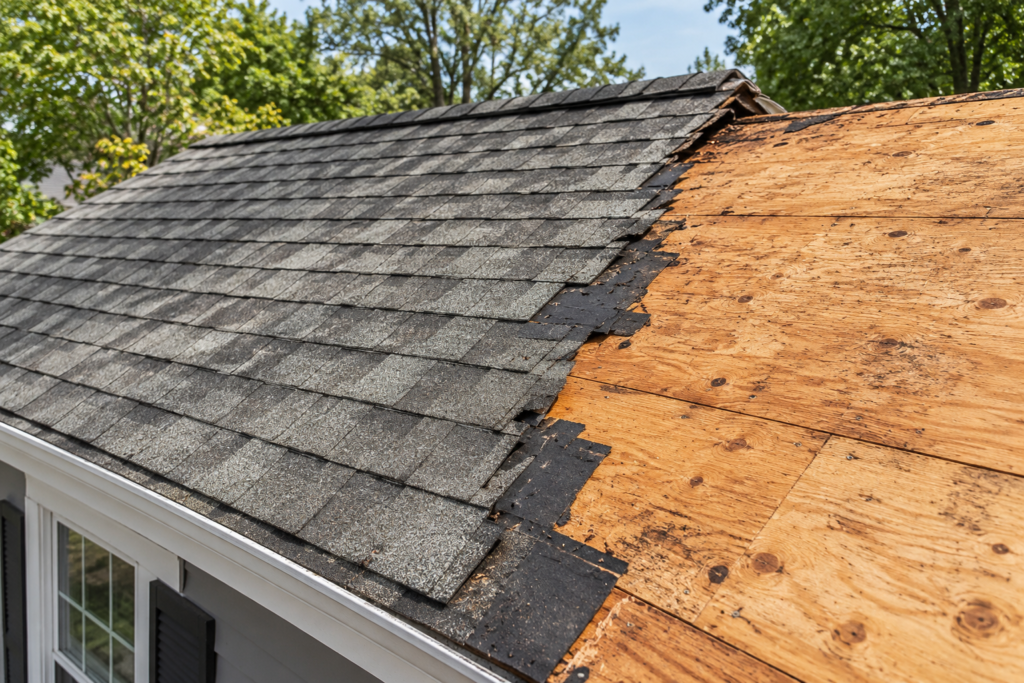
Cover image: AI-generated roofing illustration, not a photograph of a completed company project.
Roofing over existing shingles in New Jersey can look attractive when two estimates arrive with very different removal costs. The critical question is whether the existing roof can serve as a suitable base for another covering. A lower initial price has little value if the proposal leaves an unsuitable deck, uneven surface or unresolved leak beneath the new work.
A roof recover may be technically acceptable in some circumstances, but it is not appropriate for every roof. The decision requires checking the existing layers, deck condition, roof geometry, applicable construction requirements and the new shingle manufacturer’s instructions. Full removal provides access to inspect the deck and reconstruct details that an overlay may conceal.
Recover and replacement describe different scopes
A recover installs a new covering over an existing one. A tear-off replacement removes the existing covering before installing the new roof. The Asphalt Roofing Manufacturers Association’s reroofing bulletin distinguishes these approaches and explains why substrate condition and assembly suitability matter.
Ask each bidder to name the proposed method. “New roof” is not sufficiently precise. A quotation should identify what remains, what comes off, how unsuitable materials will be handled and which details will be rebuilt. Otherwise, two prices may describe substantially different projects.
Five questions determine whether a recover deserves consideration
1. What is already on the roof?
The contractor should establish the number and type of existing coverings. An owner’s recollection is useful background, but additions and previous renovations can leave different assemblies on different slopes. The assessment should address those differences rather than treating the entire house as one uniform surface.
Request the basis for the layer count and note any area that could not be checked. Do not assume that covering an older roof once makes another recover acceptable.
2. Is the deck suitable for the proposed installation?
The deck supports the roofing and receives the fasteners. A recover proposal needs a credible explanation of its condition and fastening suitability. Sagging, deterioration or unresolved moisture concerns require investigation; adding shingles does not repair the supporting structure.
Access limitations matter. An attic observation and an exterior assessment provide different information, and neither necessarily reveals every concealed condition. Ask what remains unknown before deciding whether leaving the old covering in place is a sensible tradeoff.
3. Can the new covering lie on an acceptable surface?
Curled, damaged or uneven shingles can create an unsuitable base. Manufacturer requirements are more useful than a blanket statement that overlays are always allowed or always forbidden. For example, GAF’s roofing-over-existing-shingles bulletin describes conditions for recover work and identifies situations that call for removal. Its conditions should not be generalized to every manufacturer’s product.
Have the contractor identify the exact new shingle and the applicable instructions. A general brochure about shingles is not an installation approval for the assembly on your house.
4. Can critical details be reconstructed correctly?
Discuss roof-to-wall transitions, chimneys, valleys, vents, edges and lower-slope sections individually. Ask which flashings will be replaced, which will remain and how the new roofing will connect to them. “Seal as needed” does not explain a complete water-management detail.
This is especially important when an addition meets an older house. Different roof slopes and wall finishes can make access more difficult. A proposal should identify the actual constraint and explain the proposed solution.
5. Is the complete assembly acceptable for this property?
Structural capacity, fastening, product instructions and applicable local requirements all belong in the decision. A permitted approach is not automatically the best approach for a deteriorated roof. Likewise, a contractor’s preferred method is not a substitute for checking project requirements.
For New Jersey work, clarify the property classification and scope with the municipal construction office when needed. Avoid relying on a generic internet layer limit as a complete legal determination for your building.
Compare the savings against the work being deferred
A recover may reduce removal and disposal work now. Full removal creates an opportunity to examine the exposed deck, address unsuitable areas and define the new assembly from that surface upward. Compare those scope differences before comparing totals.
| Question | What a useful proposal explains |
|---|---|
| What is being retained? | Existing layers and details, with the reason they are suitable. |
| What cannot be verified? | Concealed conditions and the limitations of the assessment. |
| What changes if removal becomes necessary? | A documented process for revising scope and approving the additional work. |
| What happens at the next replacement? | The likely implications of retaining another layer now, without pretending to know future prices. |
Do not calculate savings from removal costs alone while assuming the two completed roofs are otherwise identical. Ask whether the estimates include the same edge details, penetrations, ventilation work, cleanup and documentation. Those differences can explain part of the price gap.
When full removal becomes the stronger proposal
Full removal deserves particular attention when the existing covering is unsuitable, deck condition is uncertain, leaks remain unexplained or important transitions need reconstruction. The recommendation should connect an observed condition to a required task. Photographs and a clear scope are more persuasive than “we always do it this way.”
Conversely, a recover should not be dismissed solely because it costs less. The contractor must show why it is suitable for this roof and product. The owner can then decide whether the initial savings justify the retained materials and assessment limitations.
Questions homeowners ask
Does a recover automatically void the shingle warranty?
Do not assume either outcome. Obtain the applicable installation instructions and warranty terms for the proposed product and assembly. Ask the contractor to identify any eligibility condition that changes because existing roofing remains.
Can one roof section be recovered while another is removed?
A mixed scope requires careful detailing. Ask why the sections differ, how their transitions will work and whether the proposed methods comply with the relevant product requirements. Convenience alone is not an adequate design explanation.
Will new shingles correct a visibly uneven roof?
They should not be treated as a structural correction. Have the cause of the unevenness assessed before accepting a cosmetic covering solution.
Choose the method after assessing the roof
The right reroofing method follows from the existing assembly, its condition and the proposed installation. Start with those facts, then compare the price of a defined scope.
Contact American Siding & Construction about your New Jersey roofing project. Provide the property location, known roof history and any recurring problems so the conversation can focus on appropriate repair and replacement options.