

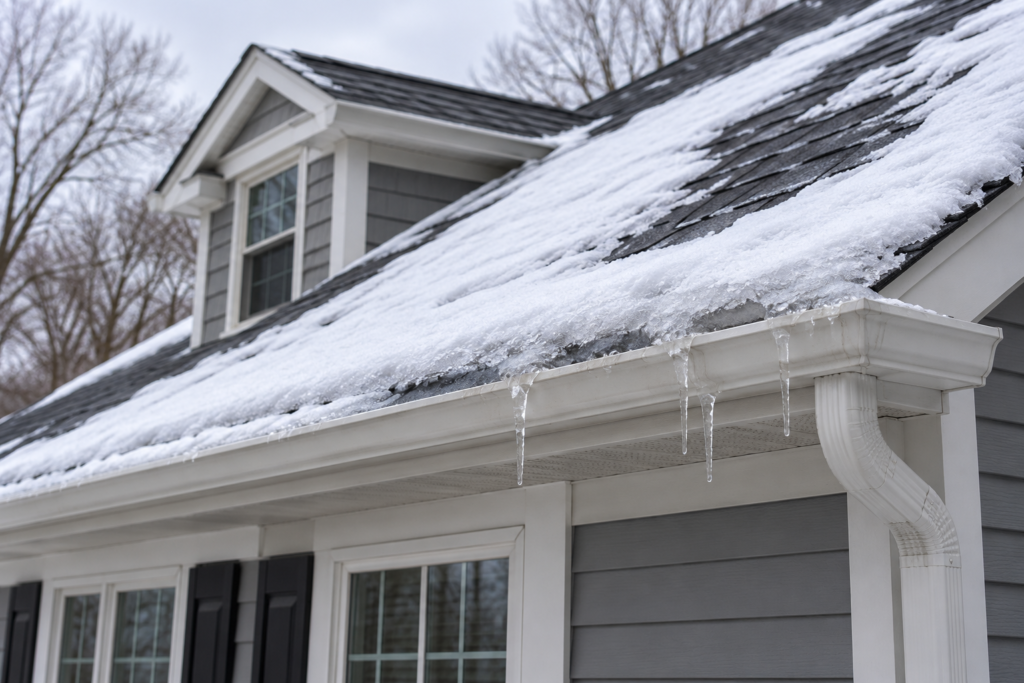
Cover image: AI-generated roofing illustration, not a photograph of a completed company project.
Ice dam prevention in New Jersey starts with understanding why snow melts unevenly on the roof. A buildup at the eaves can involve heat escaping from the house, cold exterior edges and weather conditions acting together. Treating the visible ice without investigating that pattern may leave the recurring problem in place.
An ice dam forms when meltwater refreezes near a colder roof edge and obstructs drainage. Effective prevention addresses the roof assembly and heat flow; protective roofing details help manage water exposure but do not eliminate the conditions that create the ice.
Why the edge can freeze while snow melts above it
The University of Minnesota Extension describes uneven roof temperatures as central to ice-dam formation. Heat reaching a snow-covered section can produce meltwater, while a colder lower edge allows that water to refreeze. Water held behind the obstruction may then enter the roof assembly.
This explains why the problem is not simply “too much snow in the gutter.” Gutters and roof-edge details may be part of the investigation, but removing or replacing a gutter alone does not establish that the heat-flow cause has been corrected.
Record the location and pattern of the ice from a safe position. If it repeatedly appears above the same room or roof intersection, that information can help the professional assessment. It does not prove which component is responsible.
Separate the immediate problem from prevention
If water is entering the building, communicate that active condition when seeking help. Describe any affected ceiling or wall and keep people away from unstable finishes or wet electrical areas. Do not climb onto a snow-covered roof or chip ice from the roofing.
Ask the responding professional what immediate work is appropriate and what remains to be evaluated later. A temporary measure that restores drainage or limits entry is a different scope from correcting the assembly’s recurring heat loss.
Photograph conditions before and after the work where safe. Keep a description of the method used and the areas addressed. Those records make a later prevention discussion more precise than a memory that “someone cleared the ice last winter.”
What a prevention assessment should examine
Air leakage and insulation continuity
Ask where heat can move from the occupied space into the roof assembly. The assessment should distinguish air leakage from heat flow through insufficient or interrupted insulation. The two issues can require different corrective details.
Attic access points, penetrations and changes in the ceiling shape deserve a coordinated review. A proposal that adds insulation should explain how existing moisture and air leakage will be addressed, rather than assuming that additional material resolves every pathway.
The intended ventilation arrangement
For a vented assembly, assess the intake, exhaust and connecting air paths. PNNL’s cold-weather roof guidance treats insulation, moisture control and ventilation as related parts of the design. Ventilation should not be sold as a stand-alone cure for uncontrolled heat loss.
If the roof is intentionally unvented, the assessment must follow that design. Do not add or block vents solely because another house uses a different arrangement. A qualified building-performance professional may be needed where the assembly is unclear or difficult to access.
Roofing details where backed-up water can enter
Have the roofer examine the relevant covering, transitions and protective layers. Ask which details can be evaluated directly and which remain concealed. A recurring interior symptom should be connected to evidence rather than automatically attributed to the nearest visible ice.
During replacement, clarify the proposed water-protection details and the applicable product and construction requirements. The scope should identify the actual materials and locations. A generic promise to “ice-proof” the entire roof is not a useful specification.
What an ice barrier can and cannot do
A suitable protective membrane can help resist water intrusion at vulnerable locations when properly specified and installed. It does not stop heat escaping from the house or guarantee that an ice dam will not form. Water management and formation prevention are separate objectives.
For a New Jersey project, confirm the applicable current requirements and selected product instructions. Do not assume that an old online diagram establishes the required membrane extent for every building. The roof geometry and actual scope need to be part of the specification.
Ask the contractor to explain both layers of the plan: how the work reduces the conditions contributing to ice and how the roof handles water exposure. If only one is addressed, understand the remaining limitation before approving the project.
Plan coordinated work before the next winter
After the immediate condition is resolved, assemble a short project record: dates of ice formation, interior symptoms, roof areas involved, previous work and available attic information. Use it to request a prevention assessment while the scope can be planned deliberately.
Identify the responsible trade for each task. Roofing details, insulation, air sealing and mechanical concerns may not all be included in one provider’s service. Agree on the sequence and on how completed work will be documented.
Ask what observations will be useful during the next period of comparable weather. A single winter without visible ice does not necessarily prove that every underlying issue was corrected, particularly if the weather was different. Evaluate the work against its defined objectives as well as later symptoms.
Questions homeowners ask
Do icicles prove the roof needs replacement?
No. Ice is a reason to understand the conditions and any water entry, not an automatic replacement diagnosis. Roof condition and repairability must be assessed separately.
Will a new shingle roof prevent ice dams?
Not by itself. New covering may address roofing defects, but the heat-flow and assembly conditions also need evaluation where ice dams recur.
Are heat cables the complete answer?
Do not treat them as a substitute for diagnosing the building. Any proposed electrical snow-management system needs an appropriate product, installation and operating plan. Ask what underlying conditions would remain after it is added.
Address the mechanism as well as the damage
The durable approach is to understand the heat-flow pattern, specify appropriate roof protection and coordinate any adjacent work. That creates a clearer project than repeatedly responding only to the visible ice.
Contact American Siding & Construction about recurring winter roof leakage. Share the location and history of the problem to discuss the relevant roofing scope and whether separate building-performance expertise is needed.