

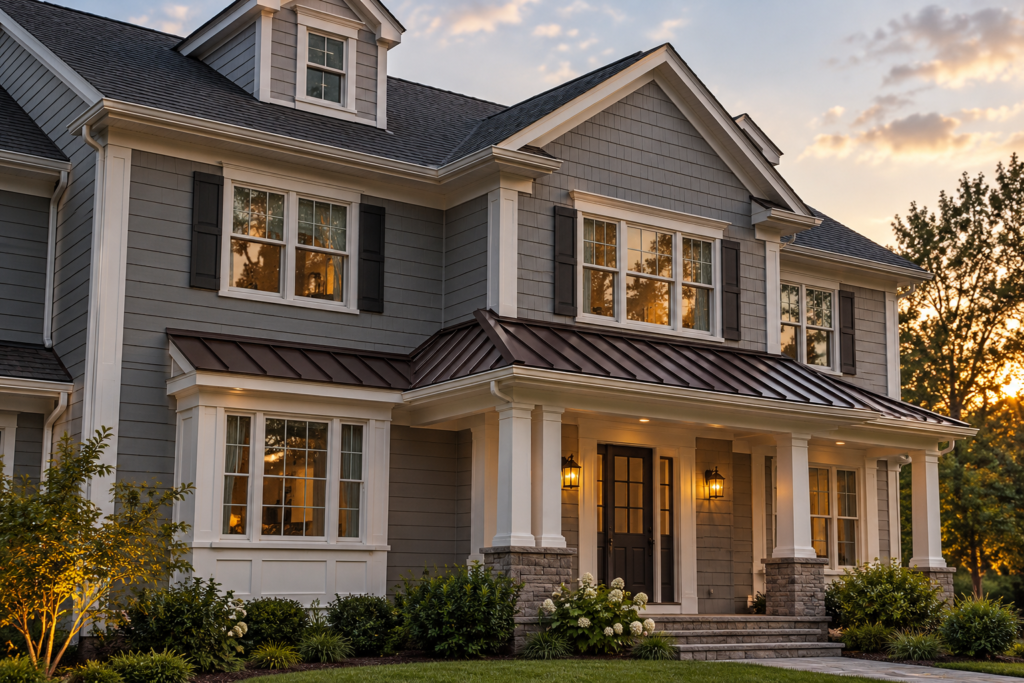
Cover image: AI-generated roofing illustration, not a photograph of a completed company project.
Comparing asphalt shingles vs. metal roofing in New Jersey is a decision about the complete installed system and how you intend to use the property. An attractive metal panel or an upgraded shingle can only be evaluated properly when the proposal also defines preparation, attachment, flashing and future care.
This guide focuses on architectural asphalt shingles and standing-seam metal as two potential options for a suitable residential roof. It explains how to compare them without assuming a universal service life, guaranteed energy savings or automatic resale return.
The direct answer: choose the option your roof and ownership plan support
Architectural shingles are worth evaluating when you want a dimensional appearance and a clearly specified shingle assembly. Standing-seam metal deserves consideration when its appearance and system characteristics suit the building and you can justify the complete project cost.
Neither material wins every comparison. Start by confirming that each proposed system is suitable for the roof’s slope, structure and exposure. Then obtain comparable scopes and confirm which material options are available for your property.
Define exactly what you are comparing
“Asphalt” and “metal” are broad labels. A shingle proposal should identify the manufacturer, product line, accessory package and installation scope. A metal proposal should identify the substrate, panel profile, coating, attachment and detail package.
Do not compare a complete standing-seam assembly with a generic exposed-fastener panel price. Sheffield Metals’ system comparison explains that attachment and movement characteristics differ. Standing-seam systems typically conceal the principal panel fasteners, while exposed-fastener systems place fasteners through the panel surface. Actual perimeter and flashing details still need review.
Likewise, different shingle profiles are not interchangeable. Ask for the exact product specifications rather than transferring a performance statement from another line made by the same manufacturer.
Compare the installed scopes side by side
| Decision factor | Architectural asphalt shingles | Standing-seam metal |
|---|---|---|
| Appearance | Compare dimensional profile, blend and roof-wide pattern. | Compare panel width, seam profile, finish and visible transitions. |
| Product definition | Name the shingle and compatible system components. | Name the metal substrate, coating, panels and attachment system. |
| Critical proposal details | Deck preparation, underlayment, flashing, edges and specified accessories. | Deck/substrate preparation, movement accommodation, penetrations, seams and edge details. |
| Future changes | Ask how repairs and new penetrations would be handled. | Ask how accessories and future penetrations integrate with the selected panel system. |
| Owner’s comparison | Evaluate documented scope and maintenance against the quoted price. | Evaluate the same factors without assuming a particular lifetime or payback. |
Use the table to identify missing information. It is not a performance rating or a statement that either option is offered for every property.
Upfront cost: separate the material choice from the existing roof
Obtain proposals for the same roof sections and the same known existing conditions. Keep removal, disposal, decking assumptions and related work visible. If one proposal includes substantial preparation and the other does not, the difference is not simply “metal versus shingles.”
Ask the contractor to distinguish common work from the incremental cost of each option. The common work might include opening the existing roof, correcting documented deck problems or rebuilding a transition. Product-specific installation can then be compared more clearly.
There is no verified company price ratio in this guide. A claim that metal always costs a certain multiple of asphalt can obscure differences in panel specification, roof complexity and installation scope. Use current written proposals for your roof.
Lifecycle cost: test assumptions instead of accepting a sales calculation
A longer planning horizon can make future maintenance and replacement more important. It does not justify assigning an exact lifespan to either roof without evidence. Ask what the comparison assumes and how the conclusion changes if those assumptions do not occur.
Build an ownership worksheet with four categories: initial installed cost, scheduled maintenance, reasonably anticipated repairs or accessory work, and any later replacement within your chosen assessment period. Keep each estimate labeled and use the same period for both options.
For a sophisticated comparison, the timing of future spending also matters. Money spent decades later is not directly equivalent to money spent today. If the decision depends on a formal financial model, use transparent timing and discount assumptions rather than adding all future amounts as though they occur immediately.
Do not assign a resale premium unless you have relevant evidence for the property and market. A roof can be a sensible purchase because it suits the building and your preferences even when a resale return cannot be quantified.
Coastal New Jersey changes the metal discussion
For a shore property, ask how the selected substrate and finish are approved for the actual exposure. Sheffield Metals’ steel-versus-aluminum guidance highlights the importance of corrosion resistance. Current coastal product offerings also show that exposure limits and written warranties can be product-specific.
Do not turn those examples into a blanket recommendation for a particular alloy. Provide the manufacturer or designer with the actual location and exposure information. Ask whether fasteners, flashings and other metals in contact with the panels are compatible.
For asphalt shingles, review the exact product and assembly requirements for the site as well. A coastal address is not a reason to assume every shingle or metal panel performs identically.
Wind performance belongs to a specified assembly
Ask how the proposed system meets the project’s requirements and which supporting documentation applies. Product ratings, attachment details, edge conditions and installation requirements should be considered together.
A warranty headline expressed as a wind speed is not a substitute for a design review. Nor does it mean that a particular roof is unaffected by every event below that number. Have the contractor explain the rating or warranty in the context of the actual product and installation.
Snow, accessories and future roof access
Ask whether snow-retention planning is appropriate above entrances, walkways or other occupied areas. This question is particularly useful when a new roof changes the surface and detailing of the existing assembly. Any accessory should be designed and attached for the selected system.
If you anticipate solar panels, rooftop equipment or another addition, raise it before selecting the roof. Some standing-seam configurations allow compatible nonpenetrating attachments, as described in Sheffield’s system guidance, but that does not approve every clamp, panel or accessory combination.
For either roof, agree on how later trades will protect the covering and handle new penetrations. A good replacement can be compromised by poorly coordinated work afterward.
Energy performance: avoid material-wide promises
Reflectivity depends on the actual surface and finish, not only on whether the roof is metal or asphalt. The Department of Energy’s cool-roof guide explains both cooling benefits and potential winter heating tradeoffs.
Ask for the product’s relevant ratings and consider the building’s insulation and heating/cooling pattern. Do not assume that a material change will produce a specific monthly saving. A color decision and a whole-building energy assessment answer different questions.
Appearance and workmanship both need a real-world review
View samples outdoors and, where possible, inspect permission-cleared examples of comparable installations. For metal, ask what visual characteristics may appear across long flat panels and how those expectations are addressed. For shingles, inspect the overall blend and pattern rather than judging a single piece.
Ask who will perform the installation and what relevant experience can be documented. An excellent contractor in one system is not automatically the right installer for every other system. The detail work, supervision and final inspection deserve as much attention as the material selection.
Make the final selection reviewable
Before committing, assemble a one-page decision record. Identify the exact products, the common preparation work, the differences in installation and the reason you prefer one option. Attach the written proposals rather than relying on a remembered price difference.
For example, an owner may prefer standing seam for its appearance while acknowledging that its additional cost has no demonstrated resale payback for the property. Another may choose architectural shingles because the defined installation meets the project’s needs at a lower quoted total. Both decisions can be reasonable when technical suitability is established and the financial assumptions are explicit.
If a proposal changes, revisit the decision record. A different panel substrate, omitted flashing task or changed removal scope is not merely a new total; it may change the comparison that supported the original choice.
Frequently asked questions
Will a metal roof always be noisier?
Sound depends on the complete assembly and interior construction. Ask about the proposed roof’s actual build-up rather than relying on the sound of rain on an uninsulated metal structure.
Does metal eliminate maintenance?
No material choice removes the need to follow the selected system’s care instructions. Ask which components require observation and who can perform suitable repairs.
Can I use metal on a porch and shingles elsewhere?
A mixed-material design may be possible, but each section and transition must be detailed appropriately. Confirm the scope and appearance as one coordinated project.
Which option is the better investment?
The answer depends on suitable specifications, actual proposals, ownership priorities and maintenance assumptions. A generic lifespan comparison cannot settle it for your home.
Make the comparison specific
Choose between fully defined systems, not marketing categories. A good decision makes the installation scope, exposure considerations and ownership assumptions visible.
Discuss your roofing priorities with American Siding & Construction. Include the New Jersey town, current roof and materials you are considering, and confirm which options the team can provide for the property.